How to Sell on FirstCry: A Step-by-Step Guide for 2026 …
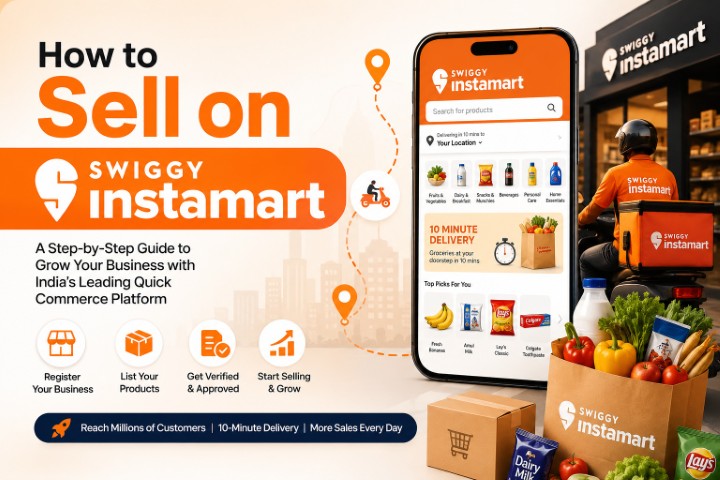
The Ultimate Guide: How to Sell on Swiggy Instamart in 2026
In the era of “10-minute delivery,” consumer behavior has shifted irreversibly. Customers no longer plan their grocery shopping; they crave instant gratification. Swiggy Instamart has emerged as a dominant player in this quick-commerce (Q-commerce) space, fulfilling thousands of orders daily within minutes.
How to sell on Swiggy Instamart
A curated quick-commerce shelf, not an open marketplace. Here's exactly how brands, distributors and grocery sellers get their products onto Instamart's dark-store network — from eligibility to going live.
A supply relationship, not a storefront you self-manage
Swiggy Instamart delivers groceries and everyday essentials in around 10–15 minutes from a dense network of hyperlocal dark stores, now spanning 131 cities. Unlike an open marketplace such as Amazon or Flipkart, you don't list your own products and set your own price freely — Swiggy buys into its dark-store inventory, and a Category Manager (CM) owns the relationship with you end to end.
Dark stores
Small, city-embedded warehouses that hold curated SKUs for near-instant picking and dispatch.
~10–15 min delivery
Speed is the product. Everything about onboarding is filtered through "can supply chain keep this fast."
Category Manager-led
One person negotiates your margins, RTV terms and launch cities — and stays involved as you scale.
What the platform actually gives you
Beyond the obvious "more sales channel" pitch, three things make Instamart worth the paperwork.
High-intent buyers
People open Instamart already meaning to buy in the next few minutes — conversion is naturally higher than browse-heavy channels.
Built-in logistics
Picking, packing and last-mile delivery are Swiggy's problem. You focus on supply and pricing, not fulfilment.
Less crowded shelves
Curated onboarding means fewer competing sellers per category than on fully open platforms — easier to be seen.
Check your eligibility
Tap each item as you confirm it. Instamart's initial screening filters on exactly these basics before routing you to a human reviewer.
- Registered Indian businessProprietorship, LLP or Private Limited — sole traders without registration aren't onboarded.
- Active GSTINWith HSN codes matching your product categories.
- FSSAI licenseMandatory if you sell any food or beverage item, state or central license.
- Consistent supply capacityAbility to fulfil recurring purchase orders on a B2B payment cycle, not one-off batches.
- Competitive, negotiable pricingRoom to work with a ~15–25% commission and still hold retail price parity.
Documents you'll need on hand
Requirements differ slightly by what you sell. Pick your category.
- GST · Registration certificate with correct HSN codes for your categories
- PAN · Business PAN card
- Incorporation · Certificate of Incorporation, Partnership Deed, or proprietorship proof
- Banking · Cancelled cheque / bank account details for B2B payment cycles
- Catalog · Product list with MRP, packaging images and top-SKU sales estimates
- FSSAI · State or central license — non-negotiable for any food/beverage SKU
- GST + PAN · Same as FMCG requirements
- Shelf-life data · Expiry windows per SKU, since perishables affect dark-store allocation
- Packaging compliance · Nutritional labelling and batch/lot coding on packs
- APOB · Additional Place of Business registration under GST for every state you'll supply into
- Regional entity proof · Warehouse or distributor tie-ups per launch city agreed with your CM
- Base documents · All FMCG/Food documents above, per operating state
Six steps from application to live inventory
Curated onboarding runs on a fixed route. Expect roughly 2–4 weeks end to end if your documents are clean.
Apply through the partner channel
Submit at the Swiggy Instamart partner portal, or email your brand deck to the Instamart brands team, with entity details, categories and monthly volume estimates.
Day 1Document & application verification
Swiggy's team checks your GST, FSSAI (if relevant) and business registration against your stated categories and scale.
~1 weekCategory Manager assigned
A CM becomes your single point of contact for everything commercial from here on.
Week 1–2Commercial & margin finalisation
You agree commission, Return-to-Vendor (RTV) terms, launch cities, dark-store allocation and pricing strategy.
Week 2New Product Introduction (NPI)
Your catalog — images, descriptions, packaging — is built into Instamart's listing system.
Week 2–3Inventory supply & go-live
You fulfil the first purchase order into allocated dark stores and your SKUs go live to shoppers.
Week 3–4What it costs, and how big the shelf is
There's no upfront listing fee — Swiggy earns through commission and, optionally, ad spend. Here's what that looks like by category, alongside how the market itself has been moving.
Typical commission range by category
India quick-commerce market share
Instamart's growth trajectory
Onboarding is the easy part
Most new sellers stall in month two, not week one. These are the levers that actually move sales once you're listed.
Common questions
No upfront fee is charged to register. Swiggy earns through commission on sales (typically 15–25% + GST) and any optional advertising spend you choose to commit.
No. Instamart onboards registered entities only — proprietorship, LLP or Private Limited — with an active GSTIN. This is a B2B supplier relationship, not a consumer-style seller account.
Most sellers go from first application to live inventory in roughly two to four weeks, assuming documents are accurate and your category has open onboarding capacity. Incomplete paperwork is the most common delay.
If you plan to supply across multiple states, you'll need an Additional Place of Business (APOB) registration under GST for each one, so you can legally invoice into dark stores there.
Return-to-Vendor terms define how unsold or near-expiry stock is handled between you and Instamart. Your Category Manager negotiates this alongside margins, so it's worth understanding before you sign off.
Ready to start the application?
Have your GST certificate, PAN, business registration and a top-SKU list ready before you apply — it's the single biggest speed lever for onboarding.
Visit the Swiggy Partner Portal →Related Posts
How to Sell on Blinkit: A Complete Guide for New …
( Flipkart profit calculator ) Master Your Flipkart Profit Margins: …
How to Sell on Myntra: Step-by-Step Registration & Onboarding Process …
GROW YOUR BUSINESS WITH OUR PREMIUM AMAZON LISTING SERVICES
Boost your sales with our expert Amazon listing services, featuring SEO optimization, professional images, and competitive strategies
How to Sell on FirstCry: A Step-by-Step Guide for 2026 free consultation The mother and child care industry in India is booming, …
How to Sell on Blinkit: A Complete Guide for New Sellers free consultation Register as a seller, List your product, Manage orders, …
( Flipkart profit calculator ) Master Your Flipkart Profit Margins: A Deep Dive into Fees & Calculator Tools 📦 Flipkart Profit Margin …
How to Sell on Myntra: Step-by-Step Registration & Onboarding Process free consultation Myntra, India’s leading online fashion and lifestyle platform, has revolutionized …